Getting started
Most founders decide what to build from a hunch. GapTheory exists to replace that with evidence: real complaints from real people, collected across the public internet and matched against your idea. Here is the whole loop, start to finish.
Describe the pain in one sentence
The box on your home screen takes a sentence describing a problem, not keywords. Write it the way the person suffering from it would say it:
“small gym owners struggle to run member challenges”
Who has the problem, and what they cannot do. That is the whole format. Searching “gym software” like a search engine will match poorly, because the evidence we hold is people describing pains, not product categories.
Read the match strength first
GapTheory compares your sentence against every Gap in the catalog and tells you how close the nearest evidence is. That lands in one of three bands:
- Strong. We hold substantial evidence about this exact pain. Read the Dossier closely, especially the parts that disagree with you.
- Partial. We found adjacent evidence: the neighborhood is real, but nobody is complaining in quite your words. Check whether the nearby Gaps are your problem seen from a different angle, or genuinely a different problem.
- Weak. People are not publicly complaining about this. That is a real result, not an error.
A weak match does not mean your idea is bad. It means the public record holds no demand signal for it, which is worth knowing before you spend six months building. Some real problems live in private channels we cannot see. But if you expected loud public pain and found silence, believe the silence.
Read the Dossier
A Dossier is the evidence package for your idea, and it is built to be argued with, not agreed with. Top to bottom:
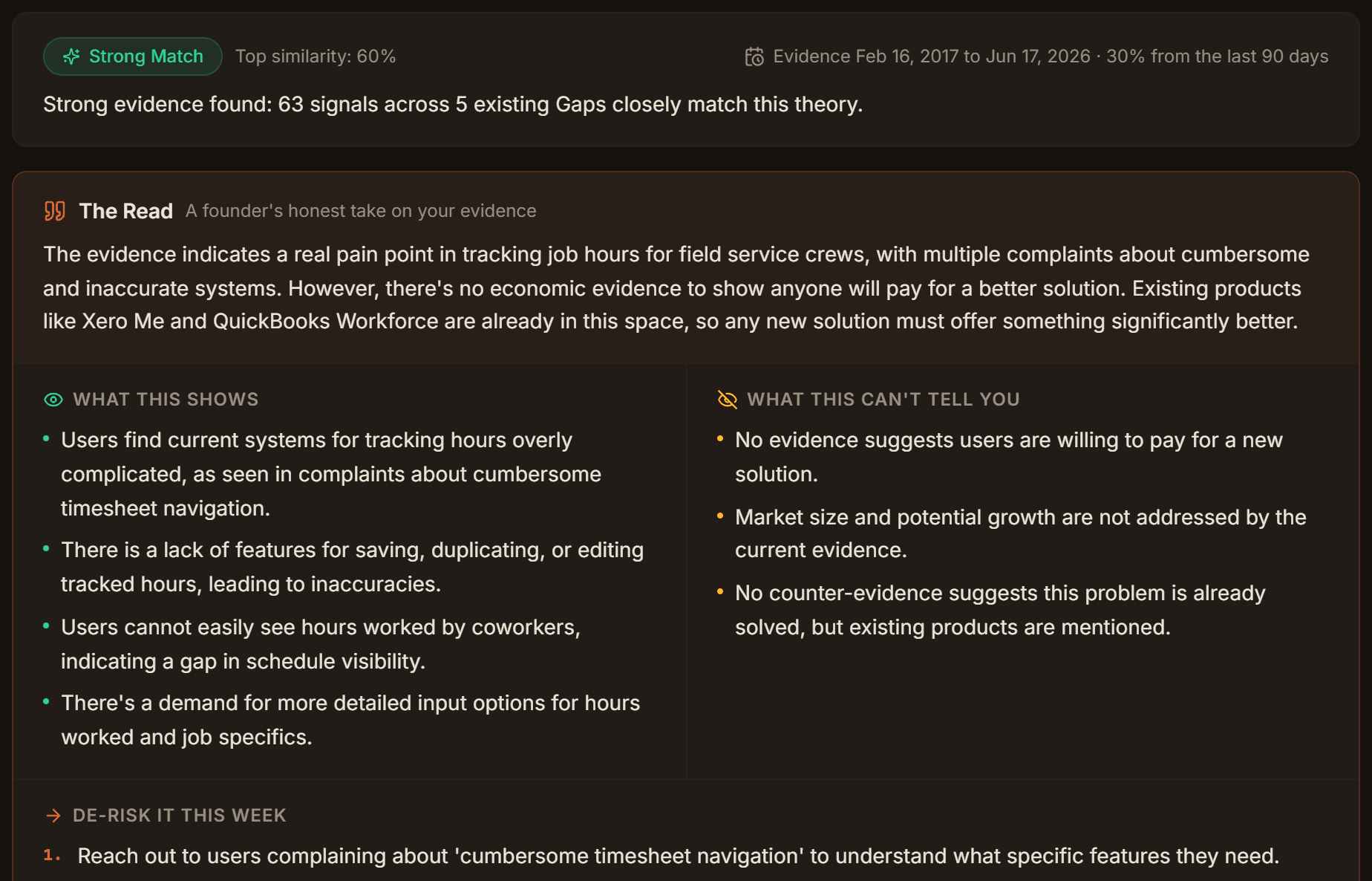
- The Read. A plain-language take: what the evidence shows, what it cannot tell you, and how to de-risk the idea this week. No scores, no hedging.
- Evidence Quotes. Real posts from real people, each with a source and date. Click through and read the originals; that is the point of them.
- Economic Evidence. People naming what the problem costs them, or saying they would pay for a fix. Complaints are cheap. A number is not.
- Counter-Evidence. People saying the problem is already solved for them. This section exists on purpose: if we only showed evidence that agreed with you, the Dossier would be flattery.
Dossiers are saved to My Dossiers automatically, so you can compare ideas over time.
Decide, then keep watching
If the evidence holds up, open the matched Gaps and go deeper: every Gap page has the full signal history, the products people are complaining about, and a Theory of why the gap exists. You can copy any Gap's evidence as Markdown or print it from its page, which is useful for pitch decks and specs.
Not ready to commit? Watch the Gap. If you watch at least one, we email you once a week when the evidence underneath it moves. You can switch this off in Settings.
No idea yet?
Start from the evidence instead. Gap Explorer is every unmet need we have found, sortable and filterable. Execution Gaps is the list of established products people are actively frustrated with. The next two guides cover both.